Verification Loop Debt Is the New Tech Debt
When I hear a similar opinion coming from multiple people I admire, I pay attention immediately.
We are onto something.
I heard similar takes from Gergely Orosz and Sunil Pai.
Gergely put it bluntly in a LinkedIn post: “Never trust the agent; verify every step it takes.”
Sunil’s version, in where good ideas come from (for coding agents), is that agents only become reliably useful when you give them constraints, context, an oracle, and a loop. Teams with a solid verification culture get leverage. Teams without it get a chaos multiplier.
My mind went to testing, of course. Tests, CI, the usual safety net. But verification is more than testing.
What I mean by a strong verification loop
A strong verification loop is how a team takes human context, a snapshot of the system, and commits it to long term storage.
So the next person, or the next machine, can see the state, understand why it is that way, and change it without breaking everything.
That includes:
LLMs need our context to produce the desired outcome. Without it they will happily produce something that looks finished and is not.
Ralph without verification does not work
There is a lot of excitement around long running agent loops. Let the model try, fail, try again, until something passes.
Here is the thing. A loop with nothing trustworthy to check against is just an expensive way to wander.
Ralph Wiggum without verification does not work.
The model can repeat itself forever and still miss the point, because it never had a clear signal for “this is actually correct.”
Why coding agents look so good
One of the reasons LLMs are so good at coding is that they can verify their work automatically.
Run the tests. Typecheck. Lint. Start the app. See if it compiled. See if the assertion failed.
Other sciences do not get that for free. They need more manual verification and a human in the loop. Software got lucky. The compiler and the test suite are a built-in critic.
Two pyramids
In the past we used to have the testing pyramid like this.
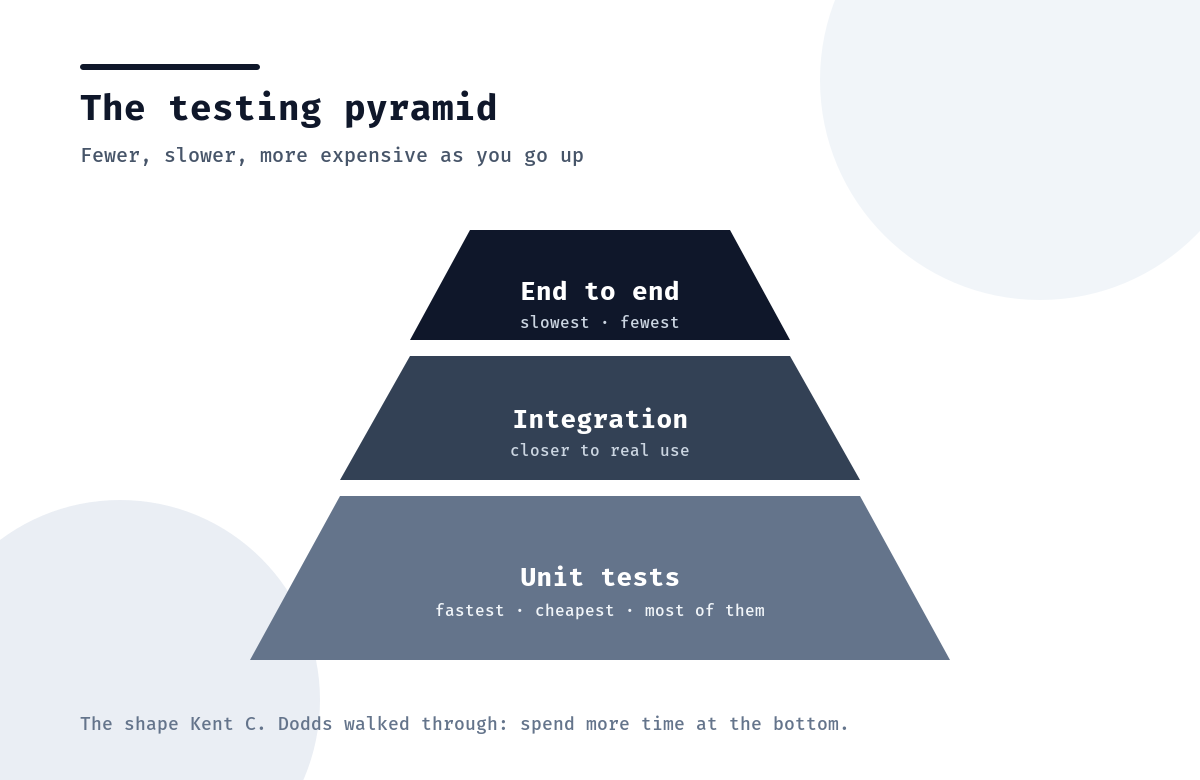
That is the shape Kent C. Dodds walked through too. Lots of cheap unit tests at the bottom. A smaller pile of integration tests in the middle. A thin layer of end to end tests at the top, because those were slower, flakier, and more expensive.
The model was about test types, and about where to spend your time. As you go up the pyramid, you write fewer tests.
Then Kent C. pushed on that shape. His testing trophy said the real return was not in hoarding unit tests. It was in integration tests, the ones that give you more confidence for the time you spend. Static checks at the base, some unit tests, a big middle of integration, and fewer end to end tests at the top. Write tests. Not too many. Mostly integration.
Then I read what Angie Jones wrote at Block about a testing pyramid for AI agents.
Here is the thing. The layers are no longer about unit versus integration versus UI. They are about how much uncertainty you are willing to tolerate.
At the bottom, they still ask a simple question: did we write correct software? Mock the model. Keep it deterministic. If this layer is flaky, that is your code, not the AI.
In the middle they record reality and replay it. Real tools. Real MCP sessions. Not because they trust the outside world to stay still, but because they want a fixture they can check against.
Higher up, a single run tells you almost nothing. They measure success rates over many runs.
And at the top they even test vibes on purpose, with rubrics and a judge, because if they do not, their users will.
If the agent can run the checks, the quality of those checks becomes the whole game.
The bottleneck moves
Here is my prediction.
As we get better at writing tests that are actually worth running, the bottleneck will not be inference anymore.
It will be compute. CI. CD. The unglamorous infrastructure that has to execute all of that verification, again and again, every time something changes.
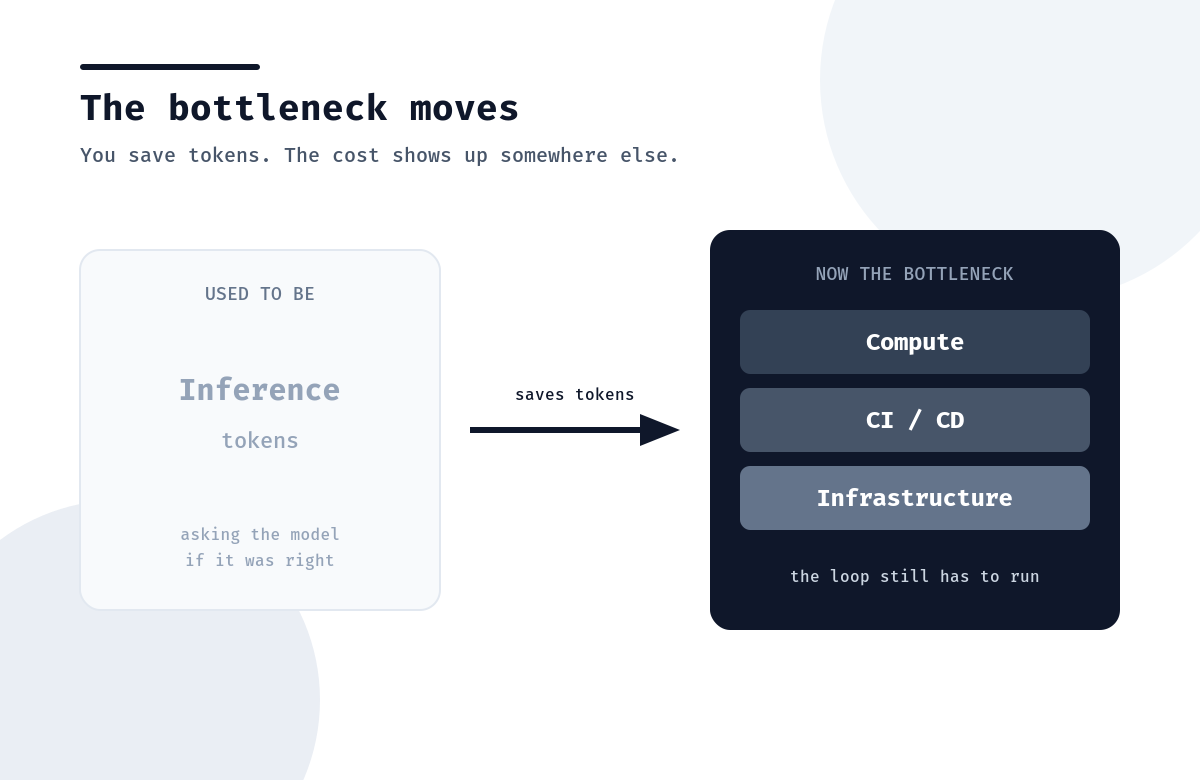
You save tokens, which is great. You stop burning money asking the model to guess whether it was right.
But you create a different bottleneck. The loop still has to run somewhere. Pipelines get slower. Runners get more expensive. Someone has to pay for the machines that keep the loop honest.
The reality is, verification does not make work disappear. It just moves the cost to a place you can see.
The new debt
Hot take: tech debt does not exist anymore.
Okay, that is a slight exaggeration. The messy code is still there.
But the debt that actually hurts you now is verification loop debt.
It is the missing test. The review nobody wrote down. The context that lived in someone’s head and never made it into the repo. The CI that is green because it is not looking at the right thing.
You can generate code faster than ever. You cannot generate trust that fast, not unless the loop is strong.
Final thought
If people I respect keep circling the same idea, I do not think it is a coincidence.
Build the loop. Store the context. Let the machines check their own work, then check the checker.
Otherwise we are just shipping vibes.